| Introduction | The instrument | The music | Maintenance | References |
| Revival | Extensions | How to play | Reed making | Links |
| Tunes for beginners | Tuning | |||
| Synthetic reeds |
|
Swedish bagpipesThe music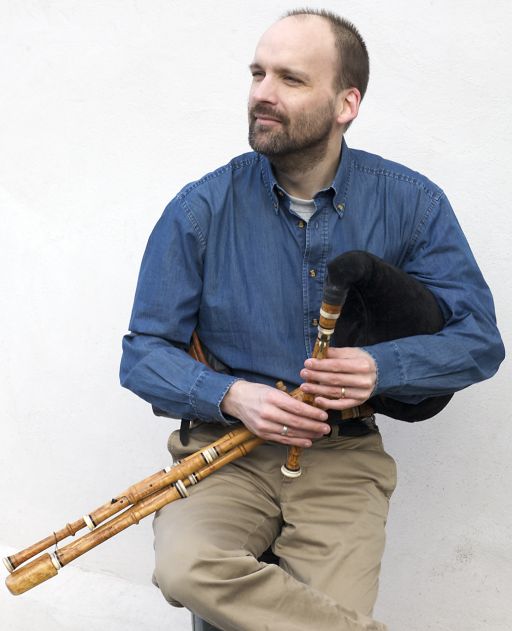 Happy piper (the author)
"Only one for whom life no longer holds
anything precious, can find it ridiculous when the Dalecarlian piper
with his bagpipe produces the most vicious sounds, but yet looks so
happy, turning his eyes to the heavens, as if in prayer. He is now
dreaming of his life's happiest moments. The melodies taught to him as
a young boy, takes the child of nature back again to the golden days of
old. Eden, usually closed, opens up and the angel, who once had to
close paradise, lowers his sword for ... the childlike mind."
C.A. Mankell 1853. Not much is known about the tunes played by the bagpipers of old, nor how they played them. There is a (very short) list of tunes known to have been played by bagpipers, but all of them passed through other instruments on their way down to us. Consequently, almost nothing is known about how, and to what extent, the old piper's ornamented their tunes. However, ornamentation in Swedish traditional music has never been that strict anyway - it is almost always improvised. So, the modern piper's ad hoc gracing may be exactly what the old pipers did as well. There is no consensus on how a Swedish bagpipe chanter should be fingered, and most chanters are very forgiving to strange fingerings. Most experienced pipers play in a half-closed manner to facilitate a trick to simulate pauses and staccato notes; The six-finger note (e' on an E/A-chanter) is normally the same, and approximately as loud, as the drone note. So, momentarily closing all six finger holes gives a very convincing illusion of a pause. This can be heard in the music examples below. You can read more about playing technique, including how to squeeze a few extra notes from your bagpipe, if you follow the link on how to play.
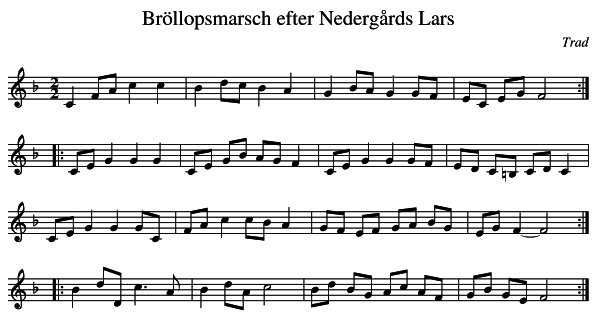
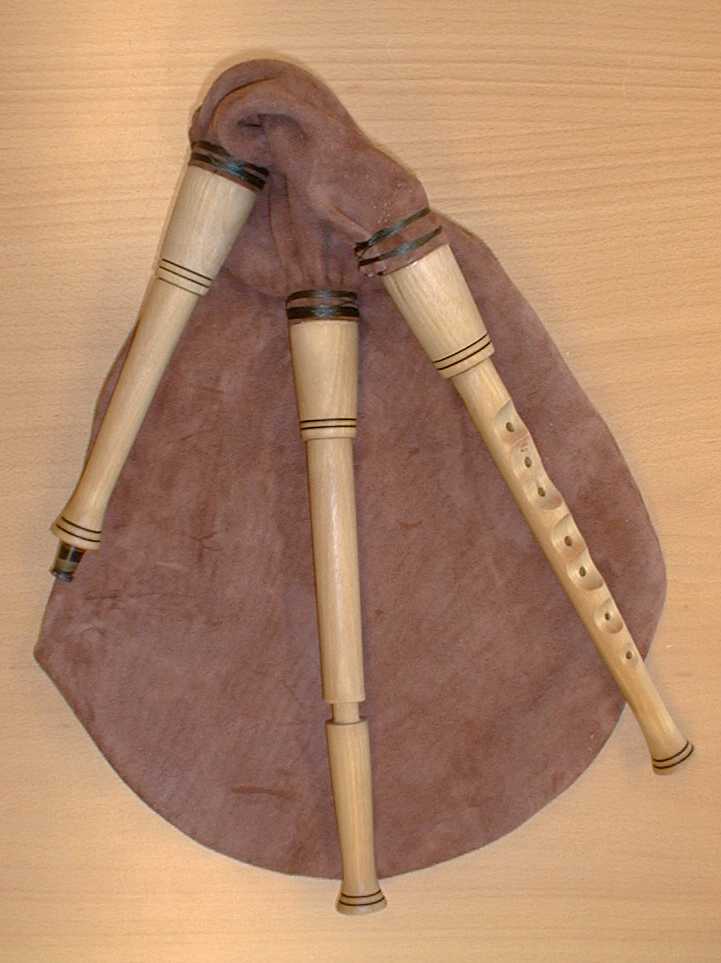 Bagpipe by Peter Frodemo The adjoining music example is one of the most well known tunes among Swedish bagpipers. It is a polska - the most Swedish of all Swedish dances (but actually with Polish roots and closely related to the mazurka and polonaise). This particular polska is attributed to Nedergårds Lars - a legendary 19th century piper from Dalarna. Nedergårds Lars was a bear hunter (among other things), which explains his nick name, "Björskötten" (the bear shooter).
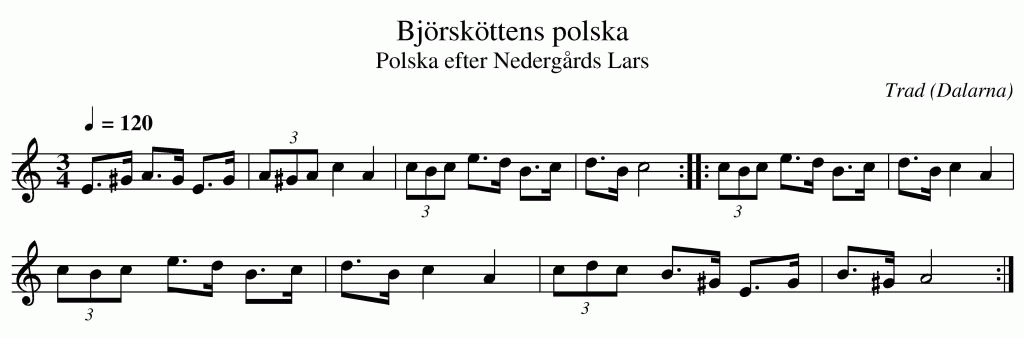 Click the music score to hear the tune (541k, 1:09, mp3) Here is a video where I play the above tune:
and here is another video, where I play a wedding march, also after Nedergårds Lars:
Visit my YouTube channel for more videos. Here are some other mp3 examples of traditional tunes, played by me on pipes made by Alban Faust:
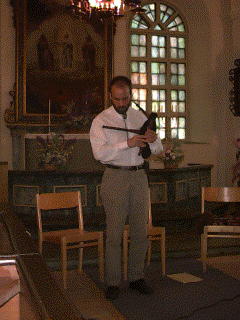
There are some more tunes under the section on Tunes for beginners, and also on my Facebook page. Collections of written musicI have compiled a few collections of tunes which fit the Swedish bagpipe well, sometimes after minor editing (in particular key changes):
A few recordingsTwo albums with an explicit focus on Swedish bagpipes are the previously mentioned Säckpipa record (LP) by Per Gudmundson (1983, re-released on CD 2015), and my own Olle Gällmo - med pipan i säcken (2008). Double Yolks with Duo Gällmo Branschke (2019) contains a mix of Swedish and German dance tunes, arranged for two Swedish bagpipes.
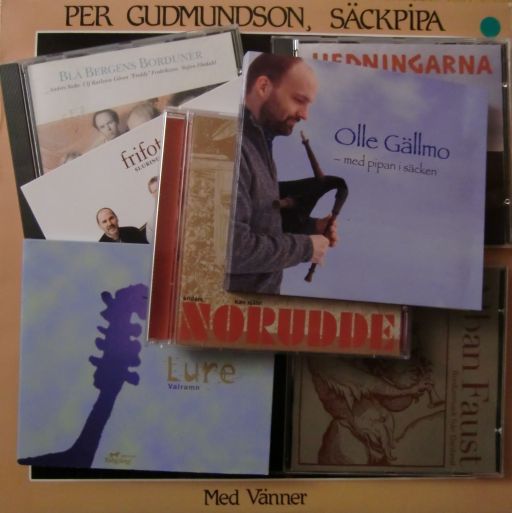
The quartet Blå Bergens Borduner (The drones from the blue mountains) include three Swedish bagpipers. Their first album, by the same name as the group, include 8 tracks with Swedish bagpipes. In 2015 they made a new CD called "Inga kônstiheter", also this one with many good bagpipe tracks. Another classic is the CD Bordunmusik från Dalsland (Drone music from Dalsland) with Alban Faust. Most tracks include bagpipes of Swedish, French, German or Flemish origin. 10 tracks include Swedish bagpipes. I also recommend the more recent Pipmakarns polska with Alban Faust and Jonas Åkerlund. Then there are a number of records where bagpipes are used, but more sparingly. Groups to look out for are, for example, Hedningarna, Lure (Valramn), Faust, Frifot, Dråm and Svanevit. Piper names to look for include Erik Ask-Upmark, Folke Dahlgren, Stefan Ekedahl, Alban Faust, Pär Furå, Per Gudmundson, Olle Gällmo, Per Jensen, Ulf Karlsson, Mikael Lund, Anders Norudde, Anton Olausson, Harald Pettersson, Anna Rynefors, Jan Winter, Jonas Åkerlund, and David Åsbrink. (Erik, Folke, Alban, Olle, Per J, Ulf, Mikael, Anders, Anton and Anna have received the honorary title "riksspelman" on Swedish bagpipe, which would roughly translate to "piper of the realm")
|
| Olle Gällmo | http://olle.gallmo.se | olle@gallmo.se |